The Buried Tales of Plants
Sometimes what we only care about plants is the overall greenery, the grand beauty, but we forgot to crouch down, to see how exactly they grow up, to find interesting details about their living habits, to see details veiled on their leaves, to feel their struggles in polluted land.
Those are the buried tales of plants, the stories being neglected. After Chuman shut down in G10, I picked up the pencils, self-taught colored-pencil drawing, and started to draw again. Yet this time is for plants
I sketched down some plants I loved at School Garden and my home backyard, and wrote down some details I observed, as a memoir of their life.

Sweet Potato
Unlike cucumbers, sweet potatoes creep along the ground, because the potatoes grow under the ground (in soil).

Hollyhock (Alcea Rosea)
Also known as "A Zhang of Red" in Suzhou
Signaling the coming of Mid-autumn Festival
Their petals are large - like umbrellas.

Cucumber
Cucumbers climb up following an iterative structure (yes the same one in math): two lateral branches, one leave, one flower, one tendril from each node
My grandmother also warns me:
1). Do not touch the yellow flowers, or the cucumbers would not grow well
2). Cucumbers growing below the topmost seven leaves should be removed, so other other cucumbers could grow better.
I don't know if any of these warnings have scientific supports, but I believe them.

Green Beans (Young)
Although they look small now, after a few weeks they can climb up the trellis pretty high.

Cucumbers (Young)
Every summer, we would set up trellis for the cucumbers to grow.


Water Spinach
The leaves of them can grow really long.
Amaranth
Although their sprouts are tiny, the final leaves can be big.

Loquat
The leaves of loquat are thick and leathery.
Actually when I was drawing this my mother criticizes that I didn't draw the leaves well. Yeah, maybe, the leaves of loquat had a very special texture

Beetroot
The leaves of beetroots are very curly.

Shamrock
You may probably know this as "three-leave" clovers.
But it actually yields flowers. At my home backyard the flowers are purple, while at some other places other species of clovers could yield white flowers.
Actually they are not considered "lucky plants" in gardening. They are considered as weeds, who steal nutriets.

Green Beans (Young)
The dark leaves at the bottom are the cotyledons; actually the three on top are the green bean’s true leaves.

Green Beans (Blooming)
Most people only notice the beans of this plants. But actually its flowers are the most intriguing part for me: they have a soft, shiny purple and are butterfly-shaped.
I would highlight the butterfly shape: The petals are entangled with each other!

Pepper
The tips of pepper leaves are very pointed. Moreover, I like the tiny pepper fruit - they are like lanterns! These small lanterns will grow up and turn from green to red in summer.

Mint
Rub a mint leaf, the juice produced can help cure mosquito bites.
I took three months to complete this mint, from June, 2025 to September, 2025. During this period I was thinking about my life, and I have encountered many people. From farmers in the brownfields to peers in Columbia Green Mountains Summer Program. When I completed I looked at every leaf I draw. Then I thought, that the leaves did not record the story of the mint, but also record the encounters of myself.

Pomegranate Flower
Pomegranate flowers bloom along the rack outside our house every summer back home. That summer in 2025, I traveled around Los Angeles and one day I spotted the same pomegranate blossoms in a garden in LA. I smiled, took out my phone, and snapped photos. A stranger woman standing nearby noticed me and smiled, "do you know its name?" "I don't know its English name, but in Chinese we call it shiliu". She repeatedly "shiliu", and I smiled, so happily. (here's another story: I drew this picture for my boyfriend that time, but I had a row with him at that day. So I kept it myself.)
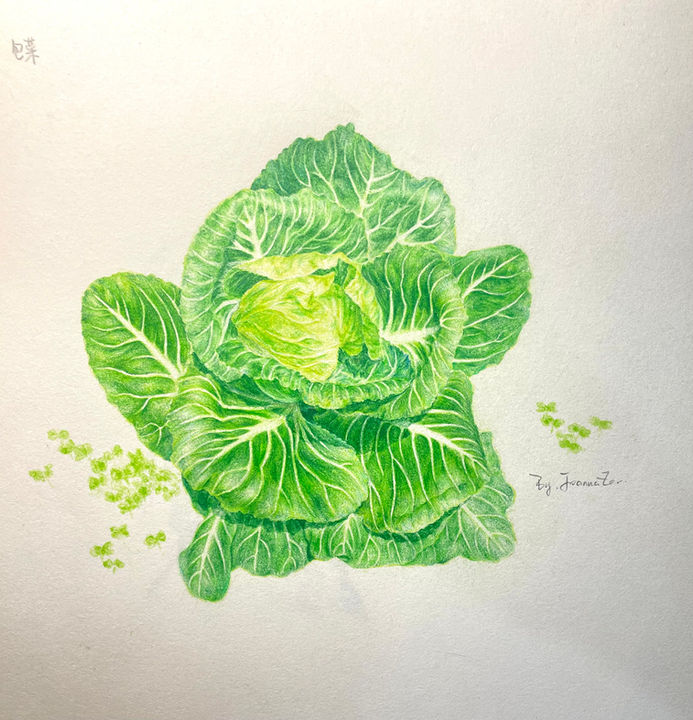
Cabbage
I like cabbage because their leaves are very, very big, and they taste good.


Some of the earliest sketches
When left Chuman, and started to draw. Sometimes I wrote some notes recording my thoughts on the pages.
Botanical Embroidery Workshop
“Thread Therapy”
In G10 and G11, I organized several embroidery art workshops at school therapy during lunch breaks, inviting students to explore the detailed structures of plants while learning embroidery.
Many students, especially those preparing for the Chinese college entrance exam (Gaokao), said that these workshops helped them relieve exam stress.


Me⬇️


My work in the workshop: Threads, Flowers, and Hair
Me and my friends organizing this event
My Study of Plants
My school only provided Chinese National Biology Course from G10 to G11 first semester, and did not provide AP Biology class. I did not have access to a lot of academic resources regarding botany.
Since besides soil pollution I'm also interested in plants, I took and completed the course Understanding Plants: What a Plant Knows in Coursera.
Afterword
Sometimes when we enter a garden, we only glanced at their overall beauty: the plants, as vessels of vivid color, give our minds a transient visual jolt.
We took "gorgeous" pictures with those creatures, letting them be the decorations of ourselves. However we often fair to crouch down to the ground, to listen to the detailed stories of their life, to observe how exactly they grow, to learn about their living habits
So I draw. I thought about how the different textures of leaves would interact with life, how the subtleties of different type of greens could be depicted by blending yellow or blue into them, where on the stem does the flower develop, what is the difference in shape between leaves.
While I draw, I understand more about the plants, and I share those findings with my teachers and my friends.
When I presented these work to my parents, to my grandparents. They understood my love; and they would let me go to field, to listen to stories, to study, to continue telling the stories about nature out.