top of page
Reclamation in School Vegetable Garden
Before Reclamation:


After Reclamation:


Plants We Cultivated:
(Squash)

(Spider Flower)

More Pictures......


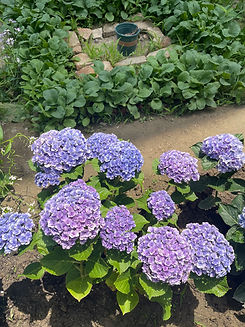

Our Work:
We school gardening team setting up gardening plans every week both during school year and during break to conduct regular gardening work: sowing, irrigating, weeding, fertilizing. Every week we gathered together holding agricultural workshops discussing how to improve and what to grow & harvest next.
We donate the product we yield to the school lab for educational use.


(Discussing how to efficiently till the soil before sowing)
(Our Gardening Schedule)
Organic Composting:
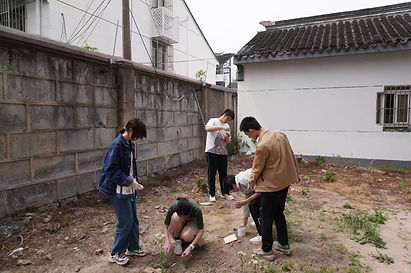
Originally, the wasteland was heavily polluted with human debris: broken tiles, plastic pieces. The soil quality there was low. As a result, I initiated a Organic Composting Project to collect vegetable scraps from school cafeteria and produce compost to fertilize the soil. We improved the soil phosphorus level by 96% from deficiency to optimal range


Pictures: Original Soil
When did not have access to expensive composting equipments. Instead of purchasing things online, we chose to use available container boxes at school and perforated them. We partnered with school cafeteria and weekly collected wasted vegetable scraps from the kitchen.


Experiments:
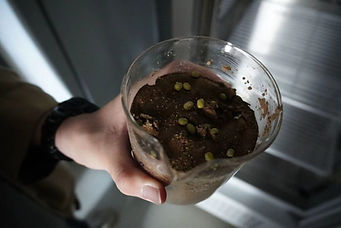
Throughout the composting process, we also held soil experiment to track soil quality or explore soil's effects on plant growth: soil texture tests, soil nutrient analysis, effects of different soil texture on the roots of bean sprouts, at-field soil infiltration tests, soil pH analysis





Efforts to quantify nutrient concentration in soil:
During one experiment trying to evaluate the N/P/K nutrient concentration in soil samples, it's diffiicult for us to access advanced laboratory apparatus at school, such as ICP elemental analysis machine or spectrometer. Instead, we figured out that the reagents provided in a soil test kit are based on a color-change reaction on soil samples. In order to quantify the concentrations, we hypothesized that the hue values of the resulting solution may have a linear relationship with the concentrations of nutrient elements present in the sample. So we captured images of the solutions after its color change under natural sunlight, extracted the color values of the solution and the color reference chart using a mobile graphic application ibisPaint, and subsequently input the data into Excel for analysis.
Using the data generated from the color reference chart, we confirmed the linear relationship hypothesis, then we built a regression model in excel and calculated the nutrient content based on the hue data.
We also utilize the similar method afterwards when conducting the experiments again.


(Our Experimental Reports)

After reclamation and composting, improvements in nutrient concentration were observed through the colorimetric reaction.
Funding:
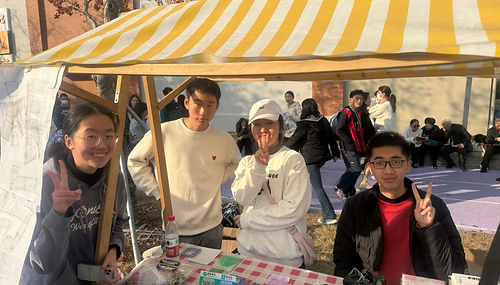
Some of our experiments & garden facility improvements still involves cost, and they were funded by the School Life & Shoots Club, which organized charity sales and other social activities to support environmental work. I also participated in charity sale and product designs in Life & Shoots club, designing school plants & goose etc. into eco-themed merch and selling them out with others.


(Financial Details)
Community Outreach:
Because our composting project was carried out well, after identifying pollution issue during my field trip to local brownfields, and knowing farmers there rely on synthetic fertilizer instead of using compost, I led the composting team to local village near the brownfield sites, building composting bins for them, teaching them organic composting techniques, and interviewing villagers there.




We taught them how to compile the scraps and soil layer by layer according to the "sandwich composting approach"
Applying the Environmental Concepts I learned:
As a gardener who knows a lot about soil and agriculture, I am very interested in how environmental concepts can be integrated into other subjects to solve real world issues. So I participated in the International Economics Olympiad Competition, working with other team members to develop a sustainable business plan to solve real world issues.
I learned from my team a lot of economic concepts. As the only one in my team having a chemistry & environmental work background, I helped my team analyze the pollution from sanitary pad and how raw materials of the pad could result in intensive input in agriculture.


Product designs & My team


(Me making presentations)
bottom of page